Making Family Game Night a Weekly Winter Habit
Once the clocks fall back, the evenings change shape. It’s dark before dinner is on the table, nobody wants to go back outside and the default plan becomes everyone drifting to separate screens in separate rooms. By January, a lot of families realize they’ve spent a whole season under the same roof without doing much together.
A weekly game night is one of the simplest ways to push back on that. It costs very little, works for almost any age mix and gives the week a fixed point everyone can look forward to. The hard part isn’t the games. It’s making the night stick past the second week.
Pick One Night and Protect It
Game night works best as a standing appointment, not a someday idea. Choose a night that’s realistically free most weeks, put it on the family calendar and treat it like any other commitment.
Friday is a natural fit for many households because there’s no school the next morning. Others prefer a Sunday afternoon or a quiet weeknight. The right answer is whichever night your family can actually keep.
Start small. An hour is plenty. A short, fun evening that ends with people wanting more is better than a marathon that leaves everyone cranky.
Expect a few misses. Holidays, sick kids and late work nights will interrupt the routine now and then. Skip the week and pick it back up. A habit survives a gap much better than it survives guilt.
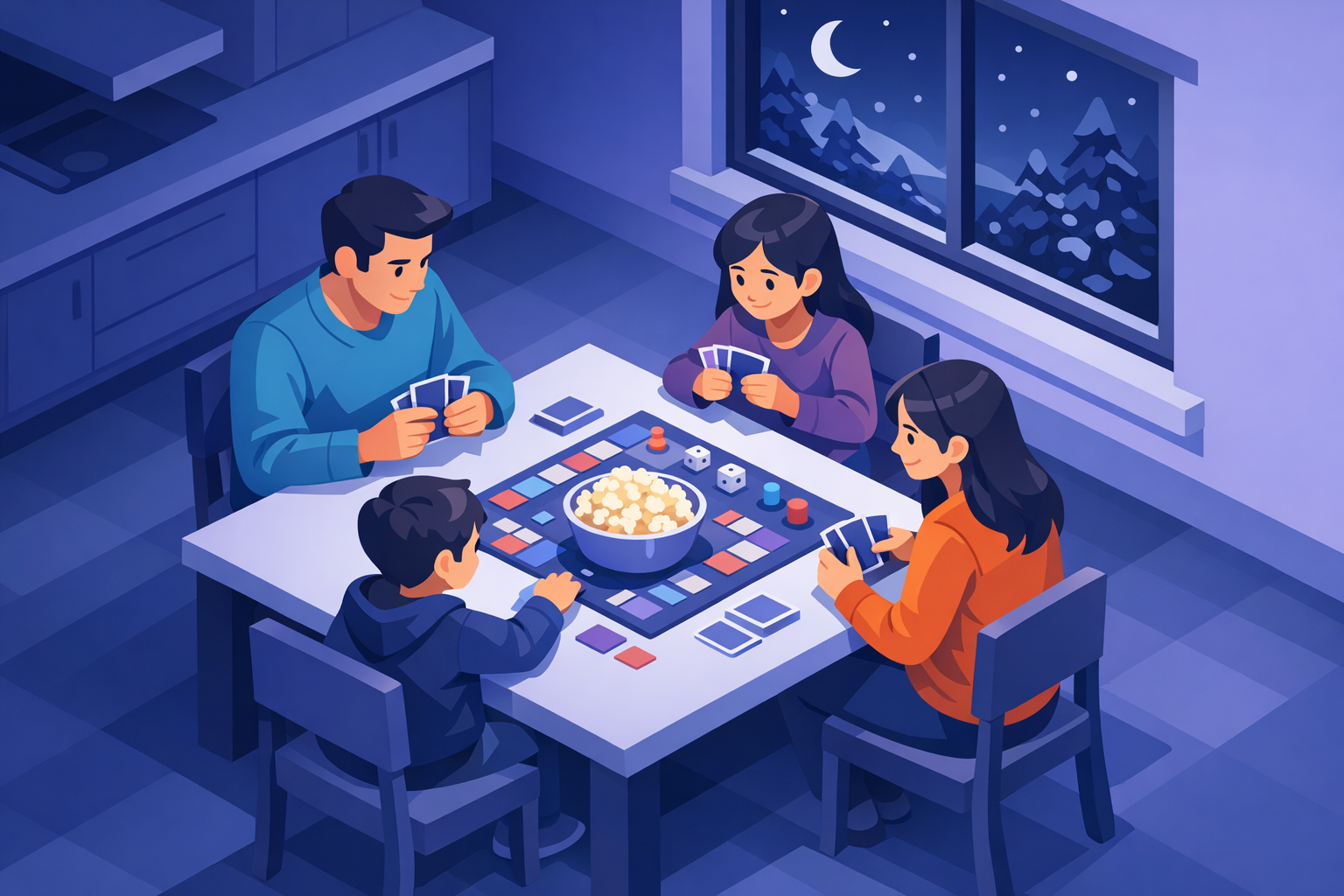
Keep the food simple. Pizza, a pot of soup or a tray of sandwiches means nobody spends the evening at the stove while everyone else plays. Some families make the snack part of the fun, with popcorn or a dessert that only appears on game night.
Build a Game Shelf That Fits Your Crew
You don’t need a big collection. A handful of games that match your family’s ages and attention spans will carry you through the winter. WorldVillage has a short piece on why jigsaw puzzles and board games make a great holiday activity, and the same thinking applies all season.
Mix quick and longer games. Short card games are great for warming up or for nights when energy is low. A longer board game can be the main event when everyone’s in the mood.
Include cooperative games. In a cooperative game, the players work together against the game itself instead of against each other. They’re a good choice for families with younger kids or siblings who get competitive.
Don’t forget the free options. Charades, twenty questions, pictionary on scrap paper and a deck of cards cover a lot of ground without buying anything.
Look at what you already have. Many families have a closet with half-forgotten games from past birthdays. Dust them off before you shop.
Let Everyone Take a Turn Choosing
Game night feels more like a shared tradition when everyone has a say. A simple rotation works: each week, a different person picks the game. The youngest might choose something simple, a teenager something more strategic and a parent an old favorite.
Rotation also solves the most common complaint, which is that the same person always gets their way. When it’s your night, you choose. When it isn’t, you play along and wait for your turn. Kids tend to accept that kind of rule easily because it’s clearly fair.
Some families add a small role for the chooser, such as picking the snack or setting up the table. It gives the person of the week a little ownership of the whole evening.
Make the Table Screen-Free
The point of game night is attention, and phones on the table compete for it. Agree on a simple rule before you start, like phones go in a basket or stay in another room until the last game ends.
This is easier when the adults go first. Kids notice when parents check messages between turns. If someone is expecting an important call, set the phone face down nearby and step away to answer it.
You’ll often find the conversation changes when the screens are gone. People joke more, kids talk about their day without being asked and the evening feels slower in a good way. There’s more on that idea in WorldVillage’s guide to why fewer notifications make for calmer family dinners.
Handle Winning and Losing Kindly
Games bring out big feelings, especially in younger kids. A little planning keeps the night fun for everyone.
Talk about good sportsmanship before you play. Simple expectations, such as shaking hands after the game and congratulating the winner, give kids a script to follow.
Model it yourself. When a parent loses cheerfully and says something like “that was a good move,” kids learn more than any lecture could teach.
Adjust for age without making it obvious. Playing on the same team as a younger child or picking games with more luck than skill can keep things balanced.
Know when to stop. If tempers are running high, end on a lighter game or call it a night. There’s always next week.
Invite the Extended Family In
Game night doesn’t have to stay inside the household. Grandparents, cousins and family friends can join in person when they’re nearby, and over video when they’re not.
Many simple games work well over a video call: trivia, word games, drawing games and charades all translate surprisingly well to a screen. If grandparents are new to video calls, WorldVillage’s grandparent’s guide to video-calling the grandkids covers the setup basics. It’s a lovely way to stay close over a long winter when travel isn’t practical.
The Evenings People Remember
Most of the details of game night won’t last. Nobody will remember who won a particular round of cards on a Friday in December. What tends to stay is the feeling: the table cleared after dinner, the snacks, the laughing over a ridiculous move and the sense that this time was set aside for each other.
Winter will be long either way. A standing game night turns a few of those dark evenings into something the whole family looks forward to, and over the years, it can become one of the traditions your kids carry into homes of their own.