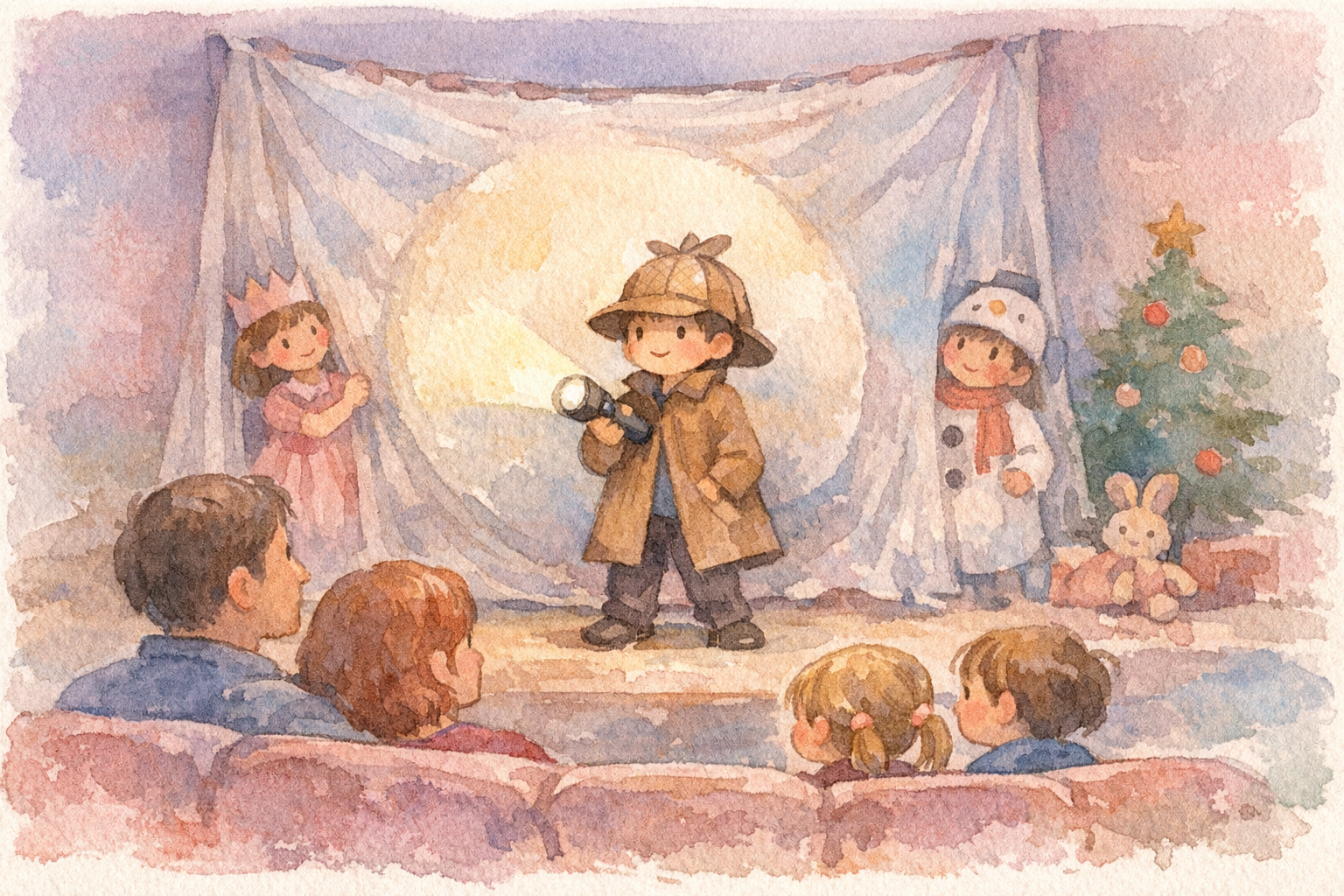
Writing a Family Holiday Play With AI for the Kids to Perform
Every big family gathering has a stretch of time after the meal when the adults want to keep talking and the kids are bouncing off the furniture. One old answer to that problem is the living room play. The cousins disappear upstairs, there’s a lot of thumping and whispering, and an hour later everyone is herded onto the couch for a show starring a dog in a cape.
An AI chat assistant can make that tradition easier to pull off, especially when you’ve got kids of different ages and nobody has time to write a script. Used well, it handles the structure and the rough draft while the kids supply the ideas, the jokes and the performance. The result still feels like theirs.
Start With the Kids’ Ideas
Before anyone opens an app, gather the cast and ask a few questions. What should the play be about? Who are the characters? Is it funny, spooky, heroic or all three at once? Let the youngest kids contribute too, even if their idea is “a turkey who’s a detective.”
Write the answers down. Those wild ideas are the raw material, and they’re what make the finished play feel homemade. The AI’s job is to help shape them, not to replace them.
It helps to decide a few practical things up front:
- How many kids are in the cast, and roughly how old they are
- How long the play should run, usually five to ten minutes for a living room audience
- Which props or costumes you already have around the house
- Whether any kids would rather run lights, sound effects or the curtain than act
Give the AI a Clear Brief
A specific request gets a much more usable draft. Instead of asking for “a holiday play,” try something like this:
“Write a short, funny play for a family holiday gathering. The cast is four kids ages 6, 8, 11 and 13. The story is about a turkey detective who has to find the missing pumpkin pie before dinner. Give the youngest child a few short lines that are easy to remember. Keep it under ten minutes. Use only props you’d find in a normal house, like a blanket, a flashlight and a cooking pot. No scary parts.”
The assistant will usually return a script with character names, stage directions and dialogue. Read it aloud before showing the kids. You’re checking for anything that falls flat, doesn’t fit your family, or gives one child far more to say than the others.
Rewrite Together
The first draft is a starting point, and the best part of the project is the rewrite. Read the script with the kids and ask what they’d change. Maybe the detective needs a sidekick. Maybe the ending should be a dance. Maybe the 11-year-old has a joke that’s better than anything in the draft.
You can feed those changes back to the AI: “Add a sidekick character who’s a confused squirrel, and change the ending so everyone dances.” Or just edit by hand. Kids who are old enough to type can make their own changes on a shared document.
Encourage them to put their own lines in their own words. The goal is a play that sounds like your kids, with the AI doing the heavy lifting on structure. If you’d like more ideas for keeping AI creations personal, our piece on making a family year-in-review video with AI help works on the same principle.
Make It Easy to Learn
Living room actors don’t memorize long speeches, and they don’t need to. Ask the AI to break long lines into shorter ones, or to add a narrator who can carry the story while the actors act it out. A narrator role is perfect for an older kid who likes being in charge, or a grandparent who wants to join in.
Print the script in a large font and let actors hold it. Nobody in the audience minds. Highlight each kid’s lines in a different color so they can find their place.
For non-readers, pair them with a helper or give them a role built around actions, sounds or a single repeated line. A three-year-old shouting “Where’s the pie?” on cue will get the biggest laugh of the night.
Props, Costumes and Sound
This is where the kids can run wild, and it’s best done with stuff from around the house. Ask the AI for ideas if you’re stuck: “What are some easy costume ideas for a turkey detective using a brown sweater, a hat and paper?”
A phone can be the sound department. Find a few free sound effects or a short music clip and assign an older kid to play them on cue. A flashlight makes a dramatic spotlight. A sheet over a doorway becomes a curtain.
You can also use an AI image tool to design a poster or program for the show, which gives early finishers something to do while others rehearse. Our guide to designing holiday wrapping paper with AI covers the kind of prompts that work well for playful family art.
Keep the Adults in the Background
The temptation to direct is strong. Resist most of it. Help with the logistics, keep the rehearsal moving, and step in if someone’s feelings get hurt or one kid starts running the whole show. Then let them figure out the rest.
Rehearsal will be messy. Lines will be forgotten, someone will refuse to wear the hat, and the squirrel may decide to improvise. That’s part of the fun.
Showtime
Announce the show with some ceremony. Set up seats, dim the lights, and have someone introduce the play. Record it on a phone if the cast agrees, because a holiday play makes a wonderful clip to watch again next year.
Afterward, give every actor a round of applause by name. Ask them what their favorite part was. Kids remember being taken seriously as creators, and by then the AI’s role has faded into the background. Next year, they may show up with the sequel already planned.